
4 BIG Health Benefits of 12 Hour Intermittent Fasting

For me, the idea of 12 hour intermittent fasting does not sound appealing. However, I only recently realized dietary fasting has unintentionally been part of my lifestyle for years now.
And the health benefits of intermittent fasting are definitely worth taking note…
- What is Intermittent Fasting?
- Intermittent Fasting Plans
- #1 16 8 Fasting
- Download our Free Beginner’s Guide
- #2 5 2 Intermittent Fasting
- #3 Eat Stop Eat (24 hour fast one day a week)
- #4 Alternate Day Fasting
- #5 12 Hour Intermittent Fasting (Our favorite method!)
- Download our Free Beginner’s Guide
- What are the Health Benefits of 12 Hour Intermittent Fasting?
- Modern Physicians are Incorporating Fasting Protocols Into their Diet Recommendations
- But Intermittent Fasting Is Nothing New!
- Download our Free Beginner’s Guide
- BIG Health Benefits of 12 Hour Intermittent Fasting
- Download our Free Beginner’s Guide
- 3 Quick Steps to Incorporate 12 Hour Fasting Into Your Day
- How to Begin and Maintain 12 Hour Intermittent Fasting
- Download our Free Beginner’s Guide
TABLE OF CONTENTS:
- Definition of Intermittent Fasting
- 5 Popular Intermittent Fasting Methods
- Quick History Lesson from Plato and Hippocrates
- 6 BIG health benefits of Intermittent Fasting
- 3 Steps to incorporate a 12 Hour Intermittent Fasting
- How to Begin and Maintain a 12 Hour Intermittent Fasting Schedule
What is Intermittent Fasting?
Intermittent fasting is an eating method that goes between fasting and eating on a consistent schedule. It is proven that intermittent fasting is beneficial in so many ways. Such as, enhanced detoxification, managing your weight and so many more.
Intermittent Fasting Plans
Here are 5 different intermittent fasting plans that can help you create the perfect intermittent fast method for your life. Fasting can make a big impact on your health, digestion and more. Keep reading for the big health benefits of intermittent fasting.
NOTE: Be sure to check with your doctor before you begin intermittent fasting. Once you get the approval, introducing the practice is simple.
#1: 16 8 Fasting
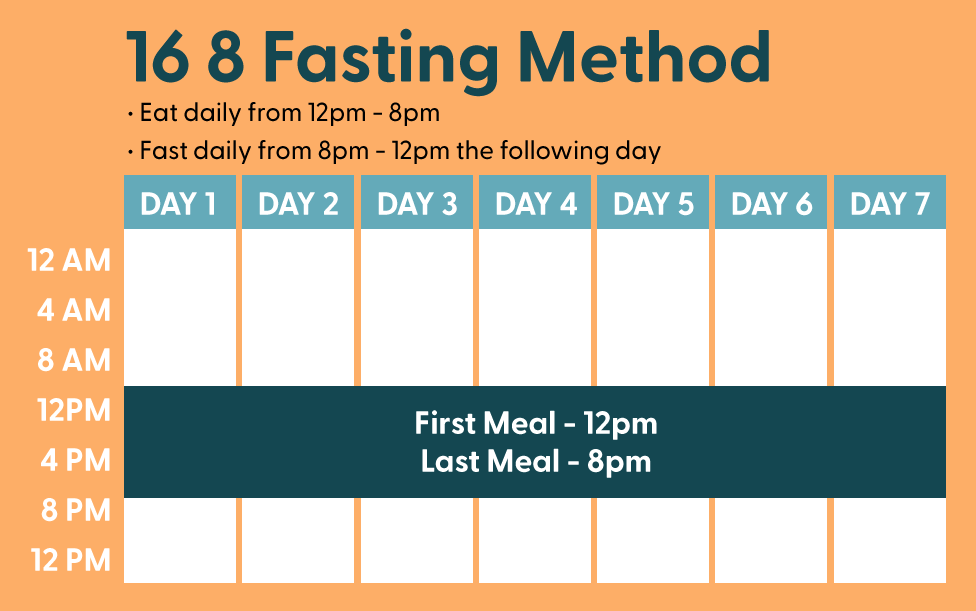
The 16 8 Fasting Method consists of eating all of your calories within an 8 hour window each day. Within this 8 hour window, it’s suggested that you squeeze in 2-3 meals.
In simple terms, you stop eating immediately following dinner and then skip breakfast the next day. For example, if you finish your last meal in the 8 hour window, then you don’t eat again until 12pm the next day. This establishes the 16 8 Fasting Method.
How to Begin 16 8 Fasting
For people that get hungry first thing in the morning, this 16 8 Fasting schedule may be a bit tough to embrace. My suggestion is to push back the morning window by 30 minutes every day or two until you’re comfortable waiting until 12pm to begin your 8 hour eating window.
You can also consider drinking water, coffee and other drinks that have no calories. This does help reduce the feelings of hunger and make it a little easier to transition.
Download our Free Beginner’s Guide
Use this Clean Cuisine 12-page Guide to jump-start your Intermittent Fasting journey!
What to Eat During the 16 8 Fasting Window
It is highly recommended that you eat healthy, whole foods. We encourage anyone that asks, to adopt a clean eating diet plan. The 8 hour window is not intended for you to slam excessive calories or poor food choices.
16 8 Fasting for Women
I’ve read numerous studies that women should not fast beyond 14-15 hours in order to best support their hormones and metabolisms. So, we don’t encourage women to take on a 16 8 Fasting method.
Our 16 8 Fasting Method Conclusion:
The 16 8 Fasting method is best suited for men that eat healthy and want to establish the health benefits from fasting 16 hours and eating their daily caloric intake in 8 hours a day.
Yes, the way I am describing this, it seems simple in theory. However, I have tried this method before and as a woman, it did negatively adjust my hormones and reduced my metabolism. Carefully consider 16 8 Fasting and work with your doctor before embracing this method.
#2: 5 2 Intermittent Fasting
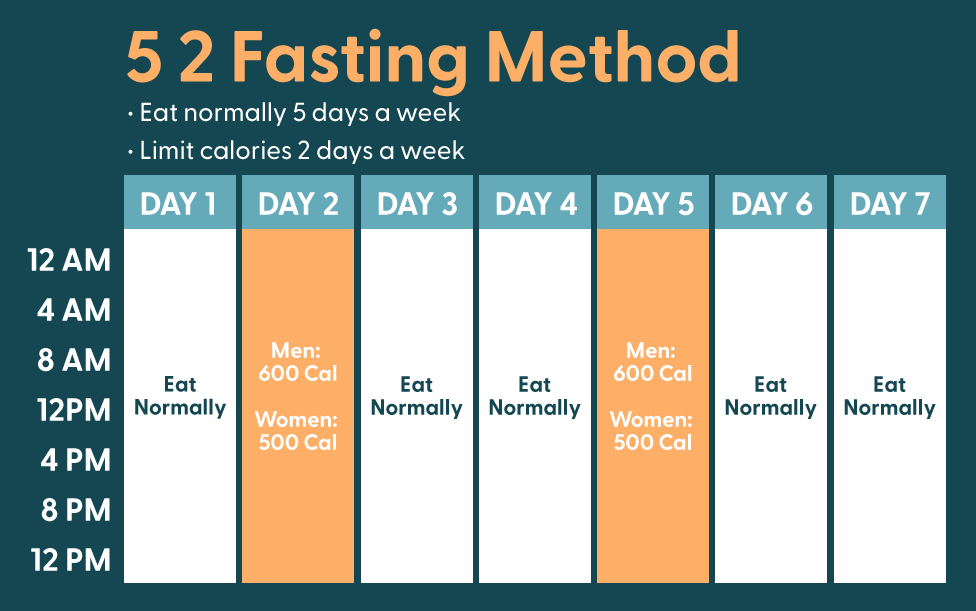
The 5 2 Intermittent Fasting method adopts 2 days a week of limited calories and 5 days of eating normally. On those 2 days of limited calories, it’s encouraged that men consume 600 calories for those days and women consume 500 calories.
How to Begin 5 2 Intermittent Fasting
You will begin by eating normally for 5 of the days each week. By eating normally, we encourage you to eat a clean, healthy diet that is filled with whole foods, healthy meats and pastured eggs.
For the 2 fasting days, you will eat 1 meal consisting of 600 or 500 (men and women respectively) or 2 meals each day consisting of 300 or 250 calories each.
Again, you can also drink water, coffee and other drinks that have no calories.
What to Eat on a 5 2 Intermittent Fast
Limiting calories on those 2 days makes it tough to create sustainable meals. Be sure to follow a clean, whole foods diet during the 5 days of eating normally. Then, choose balance whole foods such as: raw fruits and vegetables to help your stomach stay full longer. Pair this with fiber, such as oatmeal and plant-based proteins like flaxseeds and hemp seeds. A big green smoothie is also helpful.
You can also consider drinking water, coffee and other drinks that have no calories. This does help reduce the feelings of hunger and make it a little easier to transition.
Embracing the 5 2 Intermittent fasting method still reaps the health benefits of intermittent fasting.
#3: Eat Stop Eat (24 hour fast one day a week)
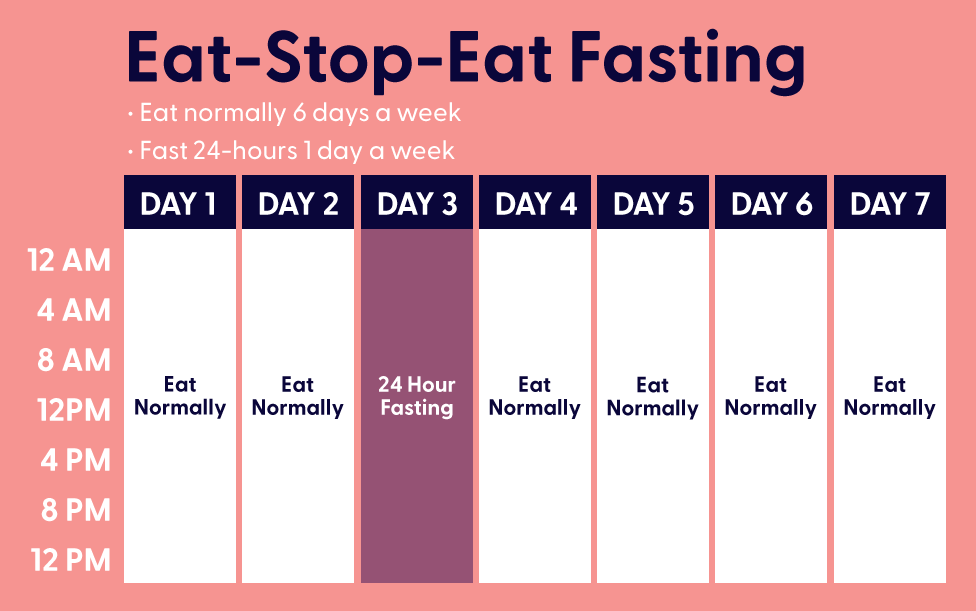
Brad Pilon shares in his book the 24 hour fast benefits and methods of Eat Stop Eat. He teaches a 24 hour fast once per week is a lifestyle that will help most people burn through the glucose they have stored in their bodies. While subsequently transitioning to using fat as an energy source instead.
During the week, you would eat normally 6 days a week and then do a 24 hour fast 1 day a week.
24 Hour Fast Benefits
The 24 hour fast benefits of 1 day a week will also provide you all of the healthy benefits of intermittent fasting. However, eat stop eat intermittent fasting is not easy to embrace and we encourage you to be mindful and ease into a fast this long.
#4: Alternate Day Fasting
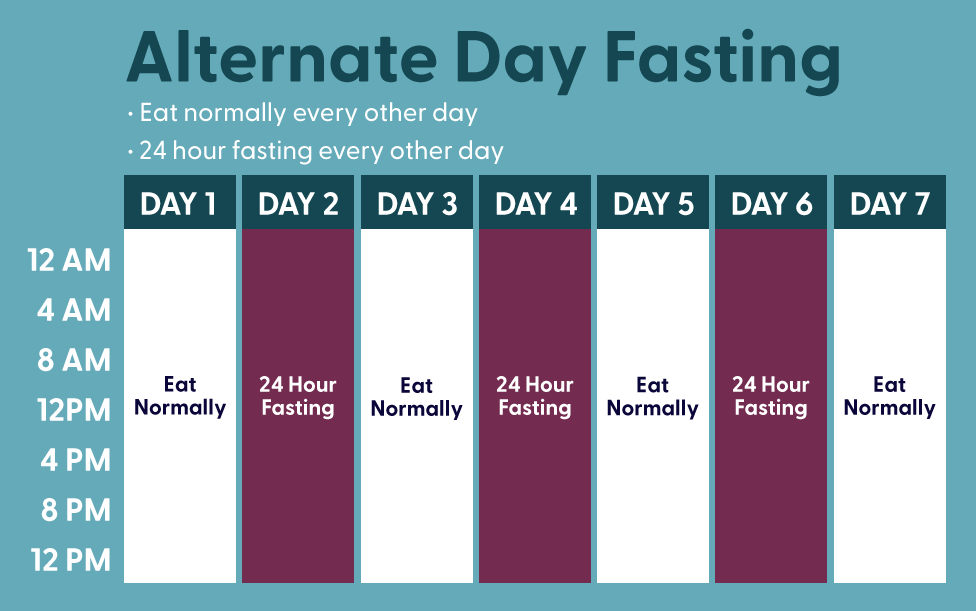
We suggest that you get comfortable with the eat stop eat method above before attempting alternate day fasting. There are several versions of alternate day fasting methods, but the 24 hour fasting method is the most common.
Again, if you’ve not intermittent fasted before, be mindful that this alternate day fasting is not for beginners and should be considered seriously.
Alternate Day Fasting Schedule
The alternate day fasting schedule consists of alternating between a full 24 hour fast and eating normally. This type of fasting is a bit extreme and should be used with cautious and under a doctor’s care.
#5: 12 Hour Intermittent Fasting (Our favorite method!)
Truthfully, the first 4 fasting plans do not sound at all that desirable to me. However, 12 hour fasting is a different story.
12 Hour Intermittent Fasting Schedule
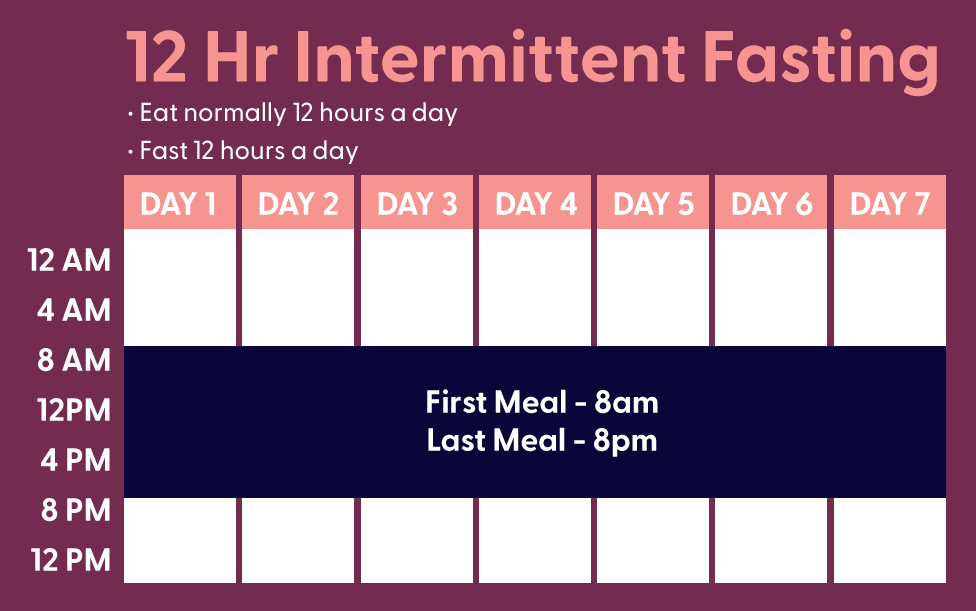
The 12 hour intermittent fasting schedule feels the easiest, least painful and most natural method of fasting. If your last meal ends at 8pm, your next meal does not begin until 8am. If you eat a late evening snack at 10pm, then you don’t eat your next meal until 10am.
This method of 12 hour intermittent fasting is flexible, much better for women’s hormones and metabolism balances. Plus, you get all of the health benefits of intermittent fasting.
Easier Intermittent Fasting Plan
In my opinion, 12 hour fasting is the easiest and least painful way to go about fasting. If you are following an otherwise nutrient dense clean eating diet, it should actually be easy to do.
Truly, if you’re interested in embracing intermittent fasting, this 12 hour intermittent fasting plan is the most pleasant way to go.
As mentioned, I have been doing it more or less by accident for years.
Download our Free Beginner’s Guide
Use this Clean Cuisine 12-page Guide to jump-start your Intermittent Fasting journey!
What are the Health Benefits of 12 Hour Intermittent Fasting?
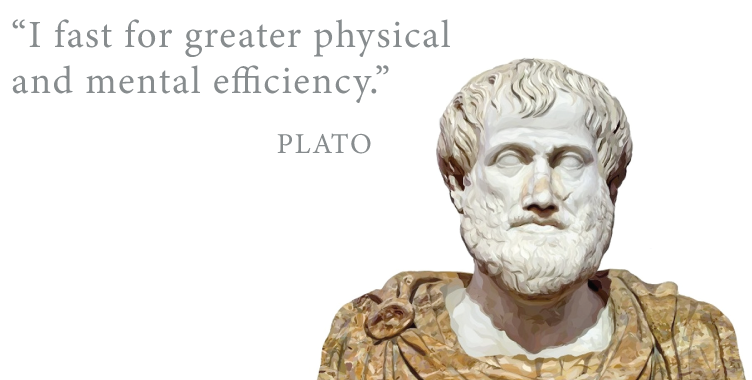
For much of human history, sporadic access to food was likely the norm, especially for hunter-gatherers. Fasting to improve health dates back thousands of years, with Hippocrates and Plato among its earliest proponents.
Although the idea of eating five or six small meals throughout the day has been popular among dieters, if you think about it, it is highly unlikely that people who lived 1000 years ago were eating three meals a day plus snacks.
Science is now starting to agree that keeping your stomach filled to the brim with food all day long might not be the healthiest thing to do after all.
More recently, fasting diets are starting to gain popularity among mainstream doctors and scientists.
Modern Physicians are Incorporating Fasting Protocols Into their Diet Recommendations
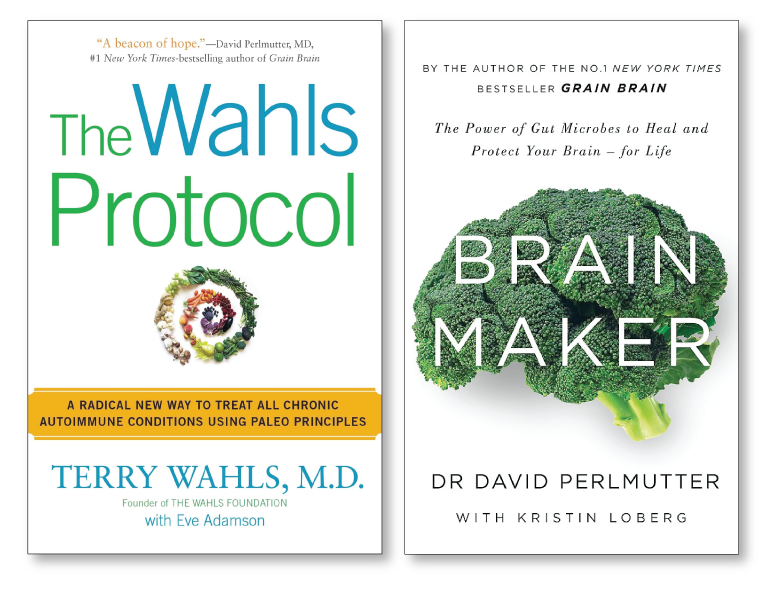
Two doctors I highly respect, Terry Wahls, M.D. and David Perlmutter, M.D., both recommend fasting in their most recent books, The Wahls Protocol and Brain Maker (see photo above.)
But Intermittent Fasting Is Nothing New!
“There is nothing new, except what has been forgotten.” – Marie Antoinette
“The best of all medicines is resting and fasting.” – Benjamin Franklin
“Everyone has a physician inside him or her; we just have to help it in its work. The natural healing force within each one of us is the greatest force in getting well. Our food should be our medicine. Our medicine should be our food. But to eat when you are sick is to feed your sickness.” – Hippocrates
Download our Free Beginner’s Guide
Use this Clean Cuisine 12-page Guide to jump-start your Intermittent Fasting journey!
BIG Health Benefits of 12 Hour Intermittent Fasting
There is good research to support a number of different health benefits of 12 hour intermittent fasting. You don’t need to avoid food for days on end to reap the benefits either! Here are some of the benefits of 12 Hour Intermittent Fasting.
#1: Improved Brain Health from 12 Hour Fasting
12 Hour Intermittent Fasting has been shown to support mitochondrial health and anything that supports mitochondrial health also improves brain health.
According to research published in Dr. Wahls book, there is even some evidence that intermittent fasting may reverse progressive brain disorders.
#2: Enhanced Detoxification.

Your body is constantly trying to detoxify itself 24 hours a day. The body uses a great deal of energy to detoxify, but it also uses a great deal of energy to digest food. When your body is not busy digesting food, it can focus its energy on eliminating toxins and healing.
Giving your body time to focus solely on cellular repair through the process of 12 hour intermittent fasting can be incredibly beneficial for optimizing detoxification.
#3: Reduced Inflammation by Intermittent Fasting
Intermittent fasting can help reduce your body’s overall inflammation. This is done through enhanced detoxification.

12 Hour Intermittent Fasting “turns on” the NRF2 gene pathway, which not only produces a dramatic increase in antioxidant protection and enhanced detoxification, but also decreases inflammation.
#4: Weight Loss / Weight Management from Fasting
In general it takes between 6 to 8 hours for the body to burn through its glycogen supply. When glycogen is depleted the body will then turn to the energy stored in fat cells.
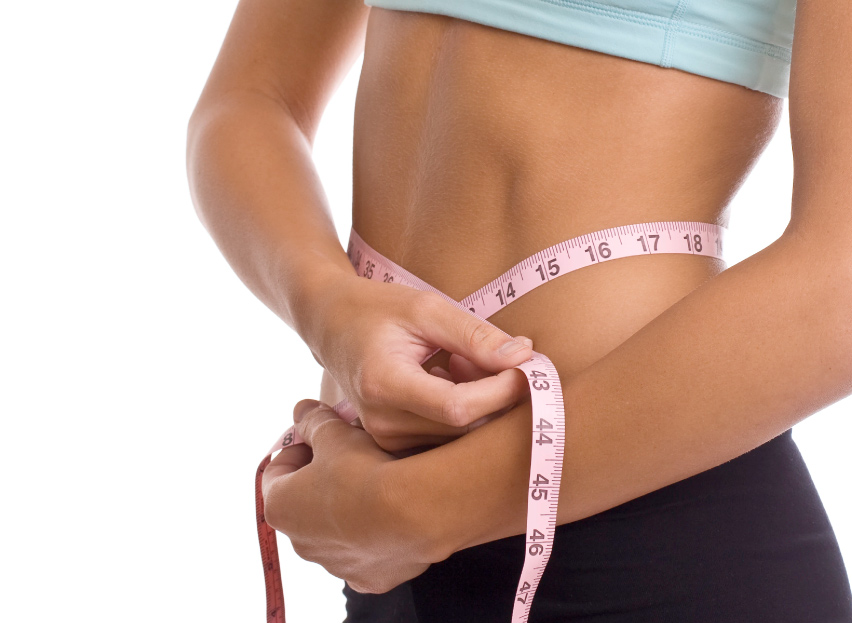
Eating throughout the day makes it much harder for the body to burn fat. Extending the time between eating with 12 hour intermittent fasting will force your body to tap into stored fat reserves.
(Since writing this post, I’ve learned so more benefits of Intermittent Fasting that I wanted to pass onto you.)
#5: Improved Workouts Thanks to Intermittent Fasting
According to PubMed, training with limited carbohydrate availability can stimulate adaptations in muscle cells to facilitate energy production via fat oxidation.

Which means, when you workout during the fasting window of your 12 hour intermittent fasting, your body gets better at burning fat for energy since there are no foods to pull from.
#6: Intermittent Fasting Can Help You Live Longer
Scientists have known for a long time that restricting calories can lengthen life. Intermittent fasting activates many of the same mechanisms for extending life as calorie restriction does.

Even Plato in 420 BC and Hippocrates in 460 BC were writing about fasting.
Download our Free Beginner’s Guide
Use this Clean Cuisine 12-page Guide to jump-start your Intermittent Fasting journey!
3 Quick Steps to Incorporate 12 Hour Fasting Into Your Day
If you want to try incorporating a 12 hour intermittent fast into your day, you’ll need to follow these important considerations:
Step #1: Leave at least 12 hours between your evening meal and your morning meal. This is called “12 hour fasting”.
In other words, if you typically eat dinner at 7 pm then you will want to wait until at least 7 am before having anything else to eat. This will leave a break of a 12 hour fast in between your eating schedule.

Step #2: Eat a nutrient-dense diet and have stable blood sugar
I should point out though that if you are new to clean eating, you may find it very difficult to go for long periods of time between meals.
Before I changed my diet, I distinctly remember how I not only always needed an after dinner snack, but I would wake up in the morning ravenous.
Step #3: Make sure that you can go long stretches without eating and still be comfortable.
And speaking of feeling comfortable, I am not at all hungry during the dinner-breakfast “fasting” window either. I don’t think it’s a good idea to ever eat when you are not hungry, but I also think it is a bad idea to let yourself be miserable and hungry for hours on end too.

Having said that, I do think if you are eating a nutrient dense diet and a solid and healthy dinner, you should find it rather easy to do a 12 hour fast. You could potentially be doing your body a big favor too!
How to Begin and Maintain 12 Hour Intermittent Fasting
Here are three ways to begin and maintain a healthy intermittent fasting routine. However, I have also shared the one main reason why 12 hour fasting may not work for you.
#1: Start Slow! Take Your Time to get to a Full 12 Hour Fast
There is no reason you need to start out fasting for the full 12 hours. This is not a sprint, it’s a marathon. It takes time for your body to adjust to not eating especially if you typically have an evening snack or grab breakfast right when you wake.
For me, I typically take my evening supplements around 9pm. Then, I wake up slow and take my time getting ready in the morning.
#2: Your Body Will Adapt – Give Your Body Time to Acclimate
When are you first starting out, you may experience some hunger pains. This is because you taught your body that you are going to feed it first thing in the morning. If you extend intermittent fasting by 20-30 minutes a day, within a few weeks you can extend your fasting period from 8-9 hours to the 12 hour fasting window.
Same things happens in the evening. Perhaps you have taught your body that when you sit down to relax after dinner, you like to have something sweet to eat. By reducing this back by 20-30 minutes a day, you can optimize your 12 hour intermittent fasting window.
#3: 12 Hours of Feeding + 12 Hours of Fasting
You have to decide when to start fasting, add 12 hours and then starting feasting. I tend to go with the 9pm – 9am fasting period and sometimes, will extend my morning by 1-2 more hours a few times a week.
This helps to keep my body guessing when I am going to feed it, which helps my focus and prolonging the detoxification process.
BUT… 12 Hour Fasting May Not Work
If you are anything like I was with hormone issues, gut imbalances, sleep issue, a liver needing detoxed or any vitamin deficiencies, 12-hour Intermittent Fasting may not work for you.
I always suggest to anyone interested in implementing a 12-hour Intermittent Fasting schedule, to get their bloodwork and labs. This helps to ensure your body is in optimal shape to change your diet.
Consider the following labs: hormones (thyroid, cortisol, estrogen, testosterone) along with vitamins and minerals.
If your lab results show an imbalance, check out a few articles at Clean Cuisine to get you back to optimal health so you can begin taking advantage of all of the 12-hour Intermittent Fasting benefits.
Download our Free Beginner’s Guide
Use this Clean Cuisine 12-page Guide to jump-start your Intermittent Fasting journey!
Have You Experimented with 12 Hour Intermittent Fasting?
If so, please be sure to leave a comment and let me know how it has worked for you!













Thank you so much..I have been trying to find support on 12 fasting..it works great for me but everyone says you should be doing 16, 18 or 24 hours..but you have made me feel more confident..it works for me
I have been doing 16/8 for about a month. I feel so much better. I also do zero carb. I couldn’t do fasting when I ate carbs, I got so desperate to eat. That is how you are when you eat carbs. I Dont understand it, BUT THAT IS HOW IT IS. There is no requirement for carbs in human nutrition. When we need glucose we can make it from fat. I need to lose fat so I am all about using my fat.
Thank you for A very interesting read. Like many others who have commented, I have been on an overnight fast for at least twelve hours for many years without actually realising it. It is, however, nice to label it and learn about it’s positive effects. Although now semi retired, shift work in earlier life was the one thing that made the fasting regime very difficult, especially night shift. I have just been listening to a radio phone in, with a doctor who was discussing this very issue. It appears the incidents of type two diabetes, high cholesterol and depression are much higher in night workers. This, in my mind, reinforces how important it is to allow the body to self detox overnight during the fasting period.
Hi Paul, I apologize for the lengthy delay getting back to you but I so appreciate you taking the time to weigh in because you are absolutely right, night workers are at a real disadvantage when it comes to eating and health. I still think you can make the 12 hour fast work for you, but it does require some planning. And yes, I think you are absolutely right that the body needs time to rest and detox (I am guessing night workers also have to be mindful of getting enough rest too.)
Thank you again for taking the time to comment!
Thanks so much for your article. I a prediabetic and trying to fast for fourteen hours a day. I can’t do a lot of “smaller” meals during the day because it tends to keep my blood sugar high all the time so I’m trying to eat three meals a day with no snacks. I have been drinking water with a slice of lemon and a couple drops of stevia in it and I’m wondering if that is allowed during the fast time. I wasn’t sure if it would raise insulin levels or not.
Hello, I Love this article. A FRIEND Suggested doing this 12hr diet and I have been doing it for the last few days after the Christmas indulge. I do find I am quite hungry but I’m getting by. Feel better already. I am vegan. I was wondering for how long I should do it for? A week? All the timd? Would love your advice, thank you
Hi David! I’m so glad to hear you like the article –thank you for the positive feedback! I’m also thrilled to hear you are starting to feel better. Ideally you should do it forever! It really does get easy though, within a week or so I think you will find your body adjusting to it and you won’t feel hungry during the “fast”. BUT, it is not optimal for your health if you are legitimately hungry (because that in and of itself will increase cortisol levels and be counterproductive to everything you are trying to accomplish) so what I would suggest if you are feeling hungry and fighting through the hunger is to just start with a 10 hour fast and wait until your body adjusts to that and then a few days later progress to an 11 hour fast and then a 12 hour fast. I hope that makes sense? Please keep me posted and let me know how it all goes!
I really like your website and your comment section. i was quite impressed with your information and the links to references. For me a 12 hour fast is easy but longer is hard. also does anyone have an opinion on eating too many nuts? I probably eat 2 servings of almonds, 2 servings of walnuts, and a serving of macadamia nuts every day. I don’t have a weight problem. I noticed that Steven Gundry, M.D. in “The plant paradox” limited nuts but i haven’t researched whether or not that is necessary if you are not worried about weight control. I also enjoy the wealth of information about the shorter fasts (less than 14 hours).
Regarding nuts and the Gundry diet-I was struggling to be vegetarian and trying to get enough protein. I was experimenting with being A balanophage- living primarily on nuts. I was eating as much nuts as I could imagine of quite a variety, almonds, walnuts, pecans, hazelnuts, macdamian, pine nuts, and I had a regular check up with my doctor who did a blood test and found I was low in protein. That made me conclude that I could not rely on nuts to meet my vegetarian protein needs, although it could be I am not good at absorbing it.
A million times thank you for this post Ivy! I’ve been wrestling with trying to make myself stick to 20:4 and 23:1 (OMAD) fasting because I was told it was best. to say that it has been a pain, is putting it insanely lightly! I am often told that 12:12 isn’t as effective. I’m going to try and switch to 12:12, I just hope my results are as impactful (a little nervous about that part). What do you eat during your eating window?
Hi Leslie! Oh gosh, I can only imagine the pain of trying to do a 20:4 or 23:1 schedule! That sounds just awful. I truly do feel you will get great results with this 12:12 schedule, assuming of course you eat clean. As for what I eat, it’s an anti-inflammatory, plant-rich (but NOT vegan) whole food diet. We explain it extensively in our Clean Cuisine nutrition book and in less detail in the upcoming Clean Cuisine Cookbook, but you can also check out the food pyramid and the basics here on this page: https://cleancuisine.com/start-here/ (just scroll down about halfway through!) I hope this helps?
And, please be sure to keep me posted on how things go with the 12:12 schedule…
Wishing you the best of luck!!
Been doing it for 19 days with great results. I am going for the 16 hour window now combined with cold morning showers for 5 minutes. I will keep you posted.
Hi George! SO good to hear! Yes, please keep me posted on the 16 hour window and the cold shower (we have a sauna in our house that I bought from Costco and at least once a week I do the sauna followed by as cold a shower as I can make it. You feel AMAZING after (but not so amazing while doing it lol) Anyway, please do keep me posted!
I have been doing it little over a month now.learned it from my wife,and I usually go to 14-16hours. I feel great,hopefully I can keep it up for longer period
thanks
My monday – Friday fast time is 6:15-6:15. does it matter if i eat later on the weekends? does the fast “work” better if you are consistent with the times of day you eat?
Hi Beverly, that’s a great question! I haven’t thought about that before and although I don’t know the answer for certain, my best guess is that it doesn’t matter as much if you are consistent from day to day with the time, but rather just make sure the window is still 12 hours. Hope this helps?
hI,
I WAS THINKING OF TRYING THE 12 HOUR FAST PLAN BUT HAVE A QUESTION – CAN i STILL DRINK BLACK COFFEE? i HAVE ALWAYS DRANK MY COFFEE BLACK AND ADORE MY morning COFFEE SO i AM NOT SURE i CAN GIVE THAT UP. i USUALLY EAT DINNER BETWEEN 6PM-8PM ( WE HAVE WEIRD SCHEDULES) AND NOT EATING BREAKFAST UNTIL 8AM IS NORMAL FOR ME – GIVING UP MIDNIGHT STACKS WOULD BE THE CHALLENGE. hOWEVER, NOT DRINKING COFFEE UNTIL 8AM IS NOT GOING TO GO WELL FOR ME.
Hi Amanda, I totally understand your concern because I too would NOT do well without coffee in am. The good news is as long as it’s black you can still drink it on the “fast” =)
Hi
i’ve been doing 12hr fast and started having strictly 3meals a day for past few weeks.
s a student i’VE ALWAYS WANTED TO wake up early by 5am, But used to feel extremely lethargic to do so.
After i have started this schedule, my body wakes me up at 5am or sometimes even early without any control from my side, This has been very surprising and motivating factor to continue the fasting. anyone reading this can sure try this out!
I’ll post my fat loss details soon, once i see any significant results.
I’m a bit confused. I always thought that not eating forced your body into “starvation” mode and made it store fat in a bid to aid survival. I know a lot of people that used to eat once per day ( dinner- probably overeating) and would be obese. When they followed nutritional counselling to eat throughout the day, they began to lose weight. Is there a balance? Perhaps too much fasting can have the opposite of the desired effect? I’d like your thoughts.
Hi Tammy, I absolutely understand why you are confused but here’s the thing, if you listen to your body and only eat when you are hungry then you will have a much easier time with weight management. Many people (including me and my husband) are not super hungry first thing in the morning but if we were to follow the conventional advice, which is to always eat breakfast, we wouldn’t necessarily be doing our body’s as much good as you might think. I am not a fan of long fasts because I agree, I do think the stress of not eating for days on end could push your body into “starvation mode”, but a short 12 hour fast is a totally different thing—ESPECIALLY if you are not naturally getting hungry during that window of time. And the more you optimize your nutrition during the time you eat, the longer your body will be able to comfortably go without food. If you are eating say donuts and coke for breakfast your body will lack nutrients and will be hungry soon after. If you ate the exact same number of calories but from a nutrient-dense smoothie with maca, acai, flaxseeds, etc. you would feel satisfied longer even though you had the same number of calories. And as long as you are not hungry during the 12 hour window, then your body is not in “starvation mode”. Keep in mind, hunger increases the stress hormone cortisol and that can start a cascade of metabolic issues, but if you are comfortable and not hungry, your body is not in stress and there is absolutely no reason to force yourself to eat just because it is “breakfast time”. I hope this makes sense?
I began using the 12-12 method almost 2 months ago out of pure trial not knowing of it being an actual weight loss program. I had been feeling very lethargic and experiencing blood pressure spikes not knowing or accepting the fact I was borderline obese. I am ‘5 8″ teetering around 225 lbs which doesn’t seem like much for most people. I used to be an avid marathon runner typically weighing about 140 to 150 lbs at most so this extra baggage was causing great stress on my knees and back. I decided I needed to do something drastic to shed these unwanted pounds even If it meant changing my eating habits. I currently weigh 200 lbs and feel much more energetic not mention my blood pressure as dropped and the inflammation in my knees is gradually subsiding. I had been contemplating knee surgery but now I am putting it off as I slowly lose the weight and inch toward my ideal body weight.
Hi Louie, thank you so much for sharing your story! And WOW! I am so very happy for your success. I can only imagine how much better you must feel! The best thing about it is that I really do feel it is doable for the long-run too. Wishing you the best of luck and thank you again for sharing your great results!
Hi Ivy
I’ve just been diagnosed with diabetes and started weight watchers. I want to manage the diabetes with weight control. So I am trying a few different things, a tablespoon of apple cider vinegar every morning at 8 a.m. and because of my job my evening meal schedule changes but I do wait 12 hours before breakfast. My question is can I take the apple cider vinegar and a chew-able multi vitamin before the 12 hours.
Thanks for all this information
Ann
Hi Ann, I applaud you for attempting to control your diabetes with diet (I have been controlling my symptoms of MS for over 20 years with diet, exercise and nutrition supplements) As for the apple cider vinegar and multi-vitamin, both are GREAT to add to your diet! Neither one will disrupt the “fast”, however, you might want to consider taking the apple cider BEFORE your meals for the most benefit. You might also want to take your multi-vitamin with food since I am assuming (if it is a standard mutlti-vitamin) that some of the vitamins will be fat-soluble, such as vitamins A, D, E, and K. The fat soluble vitamins are all best absorbed with food. I hope this helps! And please keep me posted on how things go. Wishing you the best of luck!!
Thanks for the advice. I will make the changes and keep you posted
You are welcome Ann! And yes, please do keep me posted…
Hi I am thinking of starting intermittent fasting By eating at 7am breakfast because that is normally when I finish exercise and skipping Lunch and then eating dinner Than waiting again until 7am next day and do it again. In your opinion does this make sense?Right now I stop eating at 8pm and eat again at 7am. But I have not notice any difference. Let me know your opinion
Hi Luis, Yes, this plan definitely makes sense if I am understanding it correctly. So, you are saying you want to do your “fast” in the middle of the day from 7 am till 7pm, is that right? Did you say you have been doing that already though and not noticing a difference?
Yes I started this program and I am also exercising with weight in the am so I start fast after I exercise around 7 am and eat breakfast and skipped lunch than eat dinner at 7pm. Not noticing much difference so I was also looking at doing maybe 16/8 not eating for 16 hours and eight hour eating window. What do you think? or is 12 hours good enough? I am looking to lose 15 pounds of fat.Thanks
Hi Luis, How long have you been doing the intermittent fasting? I think the 12 hours should be enough HOWEVER I would say that if 12 hours pass and you are still not super hungry, then you could absolutely push the fasting window to 14 or 16 hours. You don’t want to be uncomfortable during the fast, but you also should be hungry by the time 12 hours roll by if that makes sense? Also, be sure to look at the rest of your diet too! This blog post I did on the #1 biggest diet mistake people make might also be helpful.
Am I allowed to have a cup of coffee in the morning? Is this just about not eating for 12 hours?
Hi Misty! That’s a great question. But yes, you are allowed to have coffee, however it is super important to not add any sugar. If you need something in it, a little coconut “cream” should be ok (I say “should” because there of course is not research to back this up, but I still a think a little coconut cream in your coffee is not the end of the world.)
My first meal is at 5:30 am, my last meal is at 5:30pm, thats it until morning and it works for me, I eat 5 or 6 small meals, ……c
I started 12-hour fasting 4 months back and do it every day. The only allowance is that I drink a glass of tea without sugar or milk in the morning during this fast period. I take a 60000 IU Vit-D tablet once a month. My Blood pressure which was 150/90 most of the time is now 122/77 most of the time.
Such great news about your blood pressure!! Thank you for sharing.
I, too, have done this by accident. When I started Weight Watchers I realized that I was consuming a lot of calories late in the evening. All on “treats”. I would have a glass of wine after the kids were in bed – and what is better with wine than a bit of cheese – and you may as well have some crackers – and olives…. I instituted a no calories after 8pm rule and I never get around to breakfast before 9am. I am thinner and healthier for it.
Wow! Thanks so much for sharing Robin. I am so glad to hear it is working for you too!
It’s my first time doing this 12 hours intermittent fasting, and my body starting to adapt. I don’t have problems with it its just that I feel some headache. But it’s fine, its manageable.
Hi Erik, Thanks so much for sharing your experience. If you are having headaches though you might want to shorten the hours —-maybe start with an 8 or 9 hour fast and slowly work up to 12 hours. Once your body adjusts you shouldn’t experience any negative side effects. I hope this helps? Please keep me posted on how things go!
I’ve been doing keto for a week now with 15 or 16 hrs of fasting. Doing fantastic! ut’s handling body problems I’ve had all my life.
Hi Lucille, I am so happy you are reaping so many benefits. Although we don’t follow a keto diet ourselves, I have heard many people say they feel better and I am so glad you are one of them! Even if you don’t end up sticking with keto long term (not sure if it is safe to do that?!) I would say you can absolutely do the intermittent fasting forever. I certainly plan to! Thank you for sharing your story. Wishing you all the best!
Hi I am a college student. Is intermittent fasting good for me? I want to lose weight
I am on the ketogenic diet and have found 12 hours IF suits my schedule perfectly. I am not a breakfast eater, haven’t been since the late 1980’s and have found I have massive amounts of energy which I used to increase my workouts in the morning. Twelve hours is a perfect amount of time to fast between meals.
Thank you so much for sharing Kimberly! And I agree, I think 12 hours is just about right—it’s definitely doable if part of the time you are asleep 😉
I’m in my first week of 12/12 intermittent fasting. It’s been a super busy spring break week and I’ve had the energy to keep up with all 3 kids all week. I’m hoping the next benefit will be some weight loss!
Hi Kristina! Oh SO good to know!! Thank you for the update—please be sure to keep me posted on how it all goes. Keeping up with 3 kids is no easy feat by the way—so congrats on that alone =)
The link you provide to support your article has nothing whatsoever to do with a 12 hour fast, it is “consuming 25% of energy needs on the fast day and ad libitum food intake on the following day.” Although there is data on the kind of fasting you describe (it is called “Time Restricted Feeding,”), TRF is generally within a 6-8 hour window. There is limited data on the benefits of TRF windows as long as 12 hours. You should redirect your readers to Pubmed.com and have them search for TRF, because it is deceptive as it stands.
Thank you for taking the time to comment John. Do you have the link to any research for TRF? I actually haven’t heard of that? I first heard about Intermittent Fasting (the way I describe it) from my neurologist and have since read about it in Dr. Wahls book and also online. But I am always open to reading more and would love to fully understand the difference between TRF and IF. Thank you again!
Due to my work schedule I eat my last meal before 9pm and don’t eat again until after 9am or longer. I am 60 years old and have been doing this quite awhile. I’ve lost weight in the past. I stayed around 190 – 195. Well I guess due to age It’s not working as good but keeps me around 205 in the spring – summer and 210 in fall – winter in Kansas City. It’s hard getting back to 195. I look better and feel better. I don’t want to starve myself to death 🙁 I have very good eating habits and drink plenty of water. Any suggestions?
Hi Terence, Oh I hear you! I am almost 42 years old now and although my weight is staying the same (so far, anyway!) one thing is for sure, there is NO WAY I can eat like I did 20 years ago (this was before I started eating clean). I think it just gets harder to maintain your weight as you get older. Having said that, the #1 biggest diet mistake people make is not eating anywhere near the amount of fruits and vegetables they should ( https://cleancuisine.com/the-1-biggest-diet-mistake-people-make/ ) —and this has a HUGE impact on your weight. If you do nothing else, make it a point to eat a fruit and vegetable with every meal. Don’t think so much about all of the “bad” foods you shouldn’t eat, but rather focus on the super good foods (the fruits and vegetables!) that will make a big difference in your overall health and weight. Also! Do you do any resistance training? Just adding 20 minutes 2 times a week of a full body strength workout along with 20 minutes of interval training 3 times a week is a workout formula that will definitely help make weight loss easier.
Please keep me posted on how it all goes! Hope this helps?
During fasted state, one should drink water as much as possible to wash out toxins viz. fat in the form of urine, sweat and exhalation, can drink black coffee without sweeteners, green or black tea to boost up metabolism and antioxidants in your body. One must break fast with foods that spark least insulin levels in the blood
I have also been doing intermittent fasting without realizing. People have always given me grief when I tell them I am not hungry until 1pm. I have dinner around 6pm and sometimes a little snack afterwards (nothing later than 8pm). I wake up and have a coffee which keeps me going steady until around 1pm for my lunch. Breakfast has always made me feel a bit nauseous, unless it’s on a weekend but even then the earliest I would eat would be 10am. it’s great to know I have been doing my body good, especially without even realizing!
Hi Karissa! Thank you so much for sharing this. I am the same way (although I do get hungry a bit sooner than 1:00) —but I NEVER eat if I am not hungry. It’s just something I have never done long before I even knew it was healthy. I get sick and tired and sluggish if I eat when I am not hungry, that goes back to grade school. When I was growing up my dad always reinforced it was fine to just listen to my body and eat only when I was hungry (my mom never liked that advice he gave me lol but I still for some reason listened to him—he certainly was NOT a nutritionist. He was always very lean and healthy though! At 91 years old he STILL is.) Anyway, I am a big believer in listening to your body.
Hello, I think I’ve been kinda doing this somewhat accidentally as well. I usually eat dinner between 6/7pm. I sleep in segments so I’ll sleep from 10:30-2:30 get work, etc then It will vary what I go back to sleep but am always back up at 2pm usually eating by 3pm. So if I go from 7pm as last meal to 3pm the next day that’s 20
Hours. The only thing is I will have a bowl of fruit and some nuts around 5am and then sometimes another snack because I thought it was bad to
Go that long without eating. So I guess it’s okay ..?? What if you have blood sugar issues? I was prediabetic but reversed it with diet but I still need to be careful.
Hi Laurie,
My husband is a surgeon and we have discussed this issue a lot. We believe as long as you listen to your body that it is ok to go for extended periods of time without eating. I would NOT recommend going without eating if you are feeling hungry or lightheaded however. This is all about tuning in to your body. The thing is, if you have blood sugar issues then your body will give you warning signs. There is actually research in the medical literature that short duration fasts may be a safe, tolerable, dietary intervention in patients with type 2 diabetes ( https://www.ncbi.nlm.nih.gov/pmc/articles/PMC5394735/ ) But again, listening to your body is key. I definitely do NOT recommend fasting if you feel hungry the whole time. Instead, I would just concentrate on trying to eat only when you are hungry. I hope this makes sense?
Hi, the 5am snack kicks your body out of the fasted state, only water is allowed to benefit from a fast , not even a bite of food, or your body will produce insulin and stop burning fat.
Thank you so much for weighing in Naim!
During fasted state, one should drink water as much as possible to wash out toxins viz. Fat in the form of urine and exhalation, can drink black coffee without sweeteners, green or black tea to boost up metabolism and antioxidants in your body. One must break fast with foods that spark least insulin in the blood.
What about morning coffee with plant based creamer?!
Does your plant based creamer have any calories? If so, then no, I would not add it in during your fasting window.
Your comment is awaiting moderation.
Hi, the 5am snack kicks your body out of the fasted state, only water is allowed to benefit from a fast , not even a bite of food, or your body will produce insulin and stop burning fat.
can you use your sleep time as part of your fasting. I think 8am to 8pm eat. would this do the same thing.
yes!!! that’s the GREAT thing about it Lynda! There is no way I could fast from 8 in the morning until 8 pm, however I naturally just don’t get hungry before 8 am when I eat dinner at 8 pm, so I use sleep as part of the “fast” and then I just wait to eat breakfast until I get hungry. Today that wasn’t until 11:00.
In my experience, the results of fasting can really be astounding. Since intermittent fasting isn’t a diet, rather a pattern of eating or a way to schedule your meals so that your body gets the maximum benefit out of each one, it’s easier for people to follow. And when followed properly, intermittent fasting along with portion control (I wrote about it here: https://totalshape.com/diet/portion-control/) can be a great weight loss strategy for almost anyone.
I totally agree Michael! Thanks so much for sharing your input and the link 😉
I have been doing intermittent fasting for a few days and find a 12 hr fast to be relatively easy, but the idea of going longer is daunting to me. What I am reading is that 16 to 24 hours is much better, even if done only once a week or even less often as the body reaches a “fasting state” after 12 hrs which accelerates the benefits. I am trying to find the pattern that is right for me.
Hi Michael, I don’t think the science is totally clear-cut just yet, but yes, I think that as long as you are not uncomfortable that going longer than 12 hours could potentially be more helpful. HOWEVER, if you feel at all uncomfortable going longer then 12 hours then I would say it could actually backfire because feeling uncomfortable (and the stress of being hungry) could actually raise cortisol levels, which would definitely NOT be helpful. So I think you are doing it right by seeing what feels comfortable. Listen to your body, that’s always what I suggest. Hope this helps?