
Anti-Inflammatory Diet Tip #3: Limit Your Consumption of Animal Fat

- Saturated Animal Fat is Pro-Inflammatory
- Watch Out for AA (Arachidonic Acid) Too…
- A Cheeseburger Might Be More Harmful for Joe than John
- Science Shows Excess Animal Food Consumption is Not Healthy
- Real World Advice
- Click HERE to learn about Anti-Inflammatory Diet Tip #4
- References
- A Complete Anti-Inflammatory 8-Week Program is Outlined in Our Book…
So far in outlining my tips for following an anti-inflammatory diet I have focused on modifying the types of fats you eat. This is because the type of dietary fat you eat has the most direct connection to inflammation. Anti-inflammatory diet tip #3 requires you to limit your consumption of animal foods, which will simultaneoulsy lower your intake of pro-inflammatory animal fat, animal-based saturated fat in particular.
Saturated Animal Fat is Pro-Inflammatory
Although it seems as if everyone and their mother can now unanimously agree that trans fats do in fact belong in the trash can, some people still try to argue that because animal-based saturated fat is a natural fat it is therefore not harmful. However, just because something is natural does not necessarily mean it is healthful either. Many minerals, for example, are natural, like lead, cadmium, and arsenic, yet have no nutritive value and actually are quite toxic. Sugar and corn syrup are also “all natural” but that doesn’t mean eating these foods will promote health. Having said that, certain animal foods contain key nutrients so omitting all animal foods from your diet is not necessarily what I recommend. But I do suggest keeping a keen eye on the amount of animal-based saturated fat you intake.
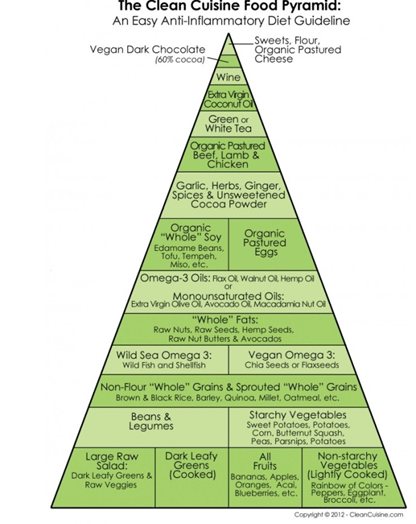
Animal-based saturated fat from foods such as beef, lamb, chicken, milk, cheese, and so forth is pro-inflammatory, especially when eaten in large quantities. Animal-based saturated fats interfere with the way your body regulates its production of natural inflammatory-regulating hormones and “messengers”. The Clean Cuisine anti-inflammatory diet I promote is not vegan but I do strongly encourage you to eliminate dairy and to limit your consumption of animal foods to no more than one modest serving a day of meat (in the form of pastured chicken, pastured beef, pastured turkey, etc.) and one “non-meat” pastured egg as a simple way to reduce your consumption of animal-based saturated fat. Note: By choosing pastured beef, chicken, eggs, etc. you will be getting less saturated fat than if you eat factory-farmed animals.
Watch Out for AA (Arachidonic Acid) Too…
Arachidonic acid—or AA—is a highly inflammatory fat that is found in animal foods, but it is especially high in factory-farmed beef, chicken and eggs and it is even found in high quantities in farmed salmon (note: if you eat too many omega-6 rich processed vegetable oils such as corn oil or “pure” vegetable oil your body can manufacture AA.) Not only do high levels of AA directly increase inflammation in the body, but also promote platelet stickiness, which is a major risk factor for heart disease.
In order to reduce AA we not only need to eat less animal foods in general, but we also need to make sure that the animal foods we do eat are of the absolute highest quality, which again means choosing pastured chicken, beef and eggs over factory-farmed options and choosing wild seafood over farmed seafood.
A Cheeseburger Might Be More Harmful for Joe than John
 Nutrigenomics (the study of the interaction between genes and diet) does make a case for the fact that animal-based saturated fat is potentially much more dangerous for some people than others. We all know the story of your neighbors’ grandma who ate bacon, lard, eggs and steak every single one of her 95 years then died peacefully in her sleep. But “n=1” anecdotes do not constitute “proof” that bacon and lard are healthy foods. Grandma might have had a genetic advantage that allowed her to tolerate her bacon-forward diet but that doesn’t mean she wouldn’t have been even better off had she had adopted a “Clean Cuisine” anti-inflammatory diet her whole life. But she lived to be 95 years old you argue! But did she live the absolute best quality 95-years on such a diet? Was she free of arthritis and pain? Did she have tremendous zip, pep and go? Did she maintain a trim figure? Was she mentally sharp? Maybe she was all of these things and maybe she was lucky to be in outstanding health her whole entire life. Maybe grandma really was an anomaly and really could eat whatever she wanted with zero negative health or weight gain consequences. But I doubt it. When you delve into nutrition research and investigate dietary patterns closely there is clear-cut association between heavy animal food consumption and negative health outcomes, including a broad spectrum of inflammatory diseases as well as heart disease (which is actually an inflammatory condition also) and cancer.
Science Shows Excess Animal Food Consumption is Not Healthy
For now I stick with the science. When it comes to animal-food rich diets, overwhelming scientific evidence shows that animal-based saturated fat and AA have powerful contributory links with artery disease (including heart attack and stroke) and cancer. The two substances most associated with substantial aging of the immune system and arteries are animal-based saturated fats and trans fats. As a side note, anything that ages your arteries will not only age your body on the inside but absolutely age your body on the outside too.
Less well publicized is that diets rich in animal-based saturated fat are highly pro-inflammatory and also contribute to fibromyalgia, multiple sclerosis, asthma, vascular dementia and psoriasis…to name just a few. As a surgeon, I operate on at least one gallbladder every week and gallbladder disease is just another condition that is also linked to animal-based saturated fat rich diets. (1)
Eating too much animal-based saturated fat can even disrupt your body’s natural fat-burning capabilities and can cause “metabolic” syndrome. This is in part because saturated fats ignite the activity of a protein called NF-Kappa B, which prevents the transport of glucose to your cells, thus triggering hunger and promoting inflammation, which slows metabolism. (2)
Eating a diet rich in animal foods will not only make your body slow and sluggish, it has the same undesirable impact on your brain. Animal-based saturated fats negatively affect your mood by disrupting the levels of neurotransmitters and the structure of cells in our brains that regulate mental processes and affect how we think and feel. Note: omega-3 essential fats have the direct opposite effect of saturated fats and have been shown to improve mood and clarity of thought.
Real World Advice
I’m not saying you can never eat a chicken, scrambled eggs or filet mignon ever again if you are trying to follow an anti-inflammatory diet. But I wouldn’t advise you eating those animal foods all in one day. My wife and I find it easiest to limit our animal food consumption by sticking to the following guidelines:
- We eat only one modest-size serving of a pastured “meat” food (chicken, beef, turkey, etc.) a day. Generally we are vegetarian until dinner time. We do eat pastured eggs though and might have an egg with breakfast or a hardboiled egg with lunch.
- At least two or three nights a week our animal food serving is omega-3 rich fatty fish (which means we do not eat a “meat” food on those days.)
- When we do eat animal foods we buy the absolute highest quality (such as pastured beef or pastured eggs or wild seafood.)
Click HERE to learn about Anti-Inflammatory Diet Tip #4
References:
- Miscianga G, et. al. “Diet, physical activity, and gallstones—a population-based, case-control study in southern Italy” Am J Clin Nutr. 1999 Jan;69(10):120-6.
- Kennedy A, et. al., “Saturated fatty acid-mediated inflammation and insulin resistance in adipose tissue: mechanism of action and implications.” J Nutr. 2009 Jan;139(1):1-4.
A Complete Anti-Inflammatory 8-Week Program is Outlined in Our Book…













One Comment